
The Prevention Through Awareness ACF/349 project examined how traditional media in Bulgaria and Norway cover domestic and gender-based violence (DVGBV). Perceptica supplied the media monitoring and analysis. This case study brings the project's findings together in one place.
Project scope and partners
The project was implemented by the Intelday Foundation, in partnership with Perceptica Ltd. and M-Brain AS, Norway, with financial support of EUR 61,500 provided by Iceland, Liechtenstein and Norway under the EEA Financial Mechanism. Its aim was to identify relevant media sources, analyse their coverage and show the role of the media in shaping the topic.
Planned deliverables were two analyses and one report, a glossary of terms, and two communication events for stakeholders. Target groups included NGOs, victims of domestic and gender-based violence, media, institutions and the general public.
Method
The analysis covered more than 7,000 articles describing cases of domestic or gender-based violence published within a year. Each publication was assessed for its approach to the topic, its tone and the vocabulary used in its headline.
Finding 1: most coverage is strictly factual
Just over half of all coverage sticks strictly to the facts provided by the responsible institutions - police, prosecutor's office, court and so on. These reports contain no emotion or attitude, regardless of the underlying tone.
Finding 2: a high share trivialises the topic
The share of publications that trivialise the topic is unexpectedly high. They focus on the scandalous or shocking side of the cases and emphasise details that have nothing to do with the essence of the problem.
Finding 3: only 5% is in-depth journalism
Only 5% of the articles can be considered quality journalistic materials that look at the situation in depth, look for the real causes and discuss possible solutions.
A small but worrying signal: 10 of the more than 7,000 articles argue that violence is normal or inevitable. The share is tiny, but their presence in the media environment is a concern.
Finding 4: headline vocabulary
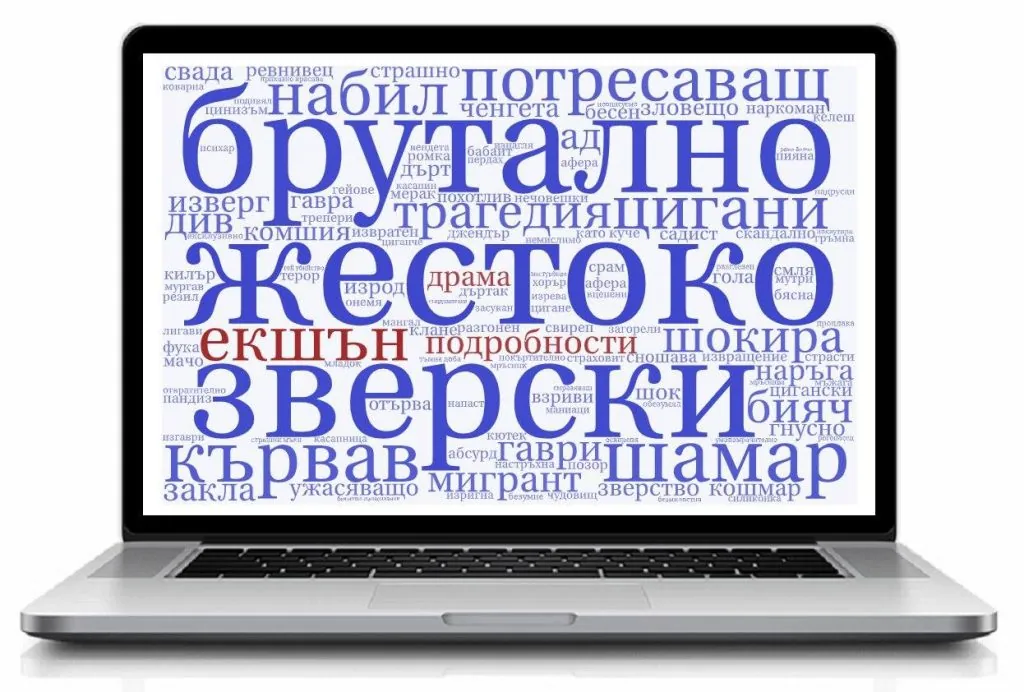
Clickbait. Words such as "action", "more details" and "drama" promise excitement but deliver no valuable information. They turn a serious community problem into intriguing content used to attract readers.
Discriminative and stereotyping language. Some headlines point to sexual orientation, ethnicity or similar characteristics that are irrelevant to the story. Ready-made expressions that draw a pseudo-logical link between a group and a crime, such as "rape-refugees" or "gay-killers", have no place in journalism and hit minority groups especially hard.
Outcomes
- On 4 June 2020, an expert round table presented and discussed the research results, focusing on causes, consequences and prevention approaches.
- OFFNews published an interview with Dr Simona Veleva, expert in Media and Digital Law and Human Rights, on the scale, causes and prevention of gender-based violence. She noted that, according to Ministry of Interior data, 35,000 signals for domestic violence were filed on 112 in 2019 - on average, 70 people a day.
What this means for brands and organisations
The same approach applies to any topic: separating factual reporting from sensationalism, measuring how often depth appears, and tracking the words headlines attach to a subject. That is how Perceptica's media analysis helps organisations understand the narratives around them, based on continuous media monitoring.
This publication was created with the financial support of the Operator of the Active Citizens Fund Bulgaria under the Financial Mechanism of the European Economic Area. The sole responsibility for the content of this publication lies with the Intelday Foundation, and under no circumstances can this document be taken to reflect the official opinion of the European Economic Area Financial Mechanism and the Operator of the Active Citizens Fund Bulgaria.